


Map Your Content Pipeline From Ideas to Results

2 Startup Content Pipeline and Backlog Examples
When you think about creating content, chart your content pipeline from capturing ideas to getting juice from that content. That forces you to see the steps in between, the different sources of ideas, and what you need beyond publishing to get juice. For anyone shipping content regularly, alone or with freelancers, that clarity pays off.
Without a pipeline, startups new to content get too attached to one idea or paralyzed by the possibilities in front of them. A pipeline helps them see the first next step. Without a place to park ideas, you feel pressure to execute on an idea immediately when you get it, which is daunting. You might get five ideas in one day and five in another month, but you cannot write five in one day. A pipeline gives you a backlog, which frees you to think of more possibilities.
As examples, I have used 2 pipelines. One was for a client. The other is how I track my content creation.
I spent 60 minutes writing and visualizing this blog. You need 2 minutes to read this.

Related:
Client pipeline
It separates how ideas are sourced and how much time goes where. I recommended this client spend 60% of content time on customer and market research (evergreen content) and 40% on trends or fads (incremental visibility). Once we choose an idea, we create job details: format and SEO expectations. Then we post the job on boards for freelancers or renew with existing freelancers. The in-house content team reviews the output, then the piece goes into the content management system (CMS, markdown, often via pull request) and we schedule it from the content calendar. We distribute on social (Reddit, LinkedIn, others) and solicit backlinks.

My pipeline
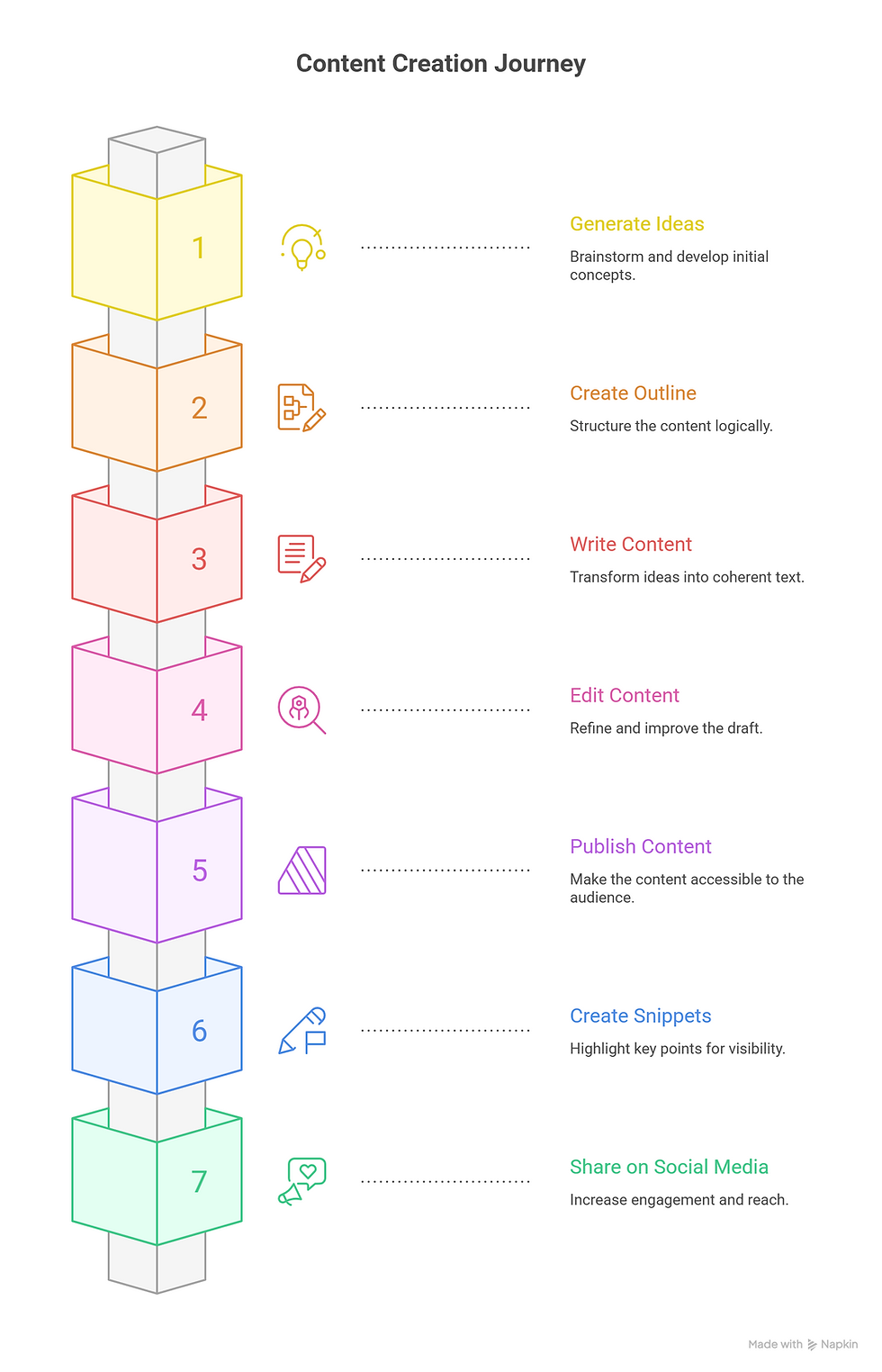
I track steps on a Kanban board:
Ideas go into an ideas backlog.
When I have more thoughts, I create an outline.
I pick from the outline or ideas bucket and write.
First draft, then edit, then publish, then snippets for social. I consider it done when I have shared on social. When items reach "publish content," I hand them to a freelancer who does the publishing task. My goal is to minimize work in progress: few items in "write content" or "edit content" at once.
Content Pipeline And Backlog Benefits
Having a content pipeline helps:
Think of more ideas.
Have ideas available whenever you have capacity to pick up.
You and your team remember what you/they are working on.
Move multiple ideas forward at once when needed (for example when guest writers are unavailable).
Track work across freelancers and scale content creation.
What's Your Content Pipeline?
Chart yours from capture to juice. The steps in between and the sources of ideas become obvious once you draw them.
Related:


